


















Entrepreneurship as Experimentation: Test, Don't Bet.
Entrepreneurship as experimentation means you stop betting on success and start testing. Harvard researchers argued that success odds are "unknowable until an investment is made." So your job is to find the smallest honest test you can afford.
The sentence that takes the weight off.
In 2014, William Kerr, Ramana Nanda and Matthew Rhodes-Kropf of Harvard Business School wrote in the Journal of Economic Perspectives. They described the probabilities of success as "low, extremely skewed, and unknowable until an investment is made." However, unknowable does not mean you lack brains or courage. Instead, in their argument, nobody can know until somebody actually tries.
Why entrepreneurship as experimentation changes the question.
You no longer have to decide whether your business will succeed, because nobody can decide that in advance. Instead, you decide how to test a business idea small, and whether you can afford it. Also, chapter 7 showed founders trained to treat ideas as hypotheses. Many stopped sooner, while those who continued tended to do better.
A small start is the version that finds out.
A small start is not a weaker version of a big start. Therefore, the smallest test of a business idea should not be the cheapest or the most impressive option. Instead, it is the smallest step that gives you a real answer from a real customer. Seen through entrepreneurship as experimentation, that answer is the whole point.
Design your entrepreneurship as experimentation step.
Write the smallest step that would get a real answer from one real customer.
Then write whether you can afford it and run it this month.
From the book.
That changes the question you've been asking yourself. You do not have to decide whether your business will succeed, because nobody can decide that in advance. You only have to decide what the smallest honest test of it would be, and whether you can afford that test. Chapter 7 showed you what happened when founders were trained to treat their ideas as hypotheses: many of them stopped sooner, and the ones who continued tended to do better. A small start isn't a weaker version of a big start. It's the version that finds out.
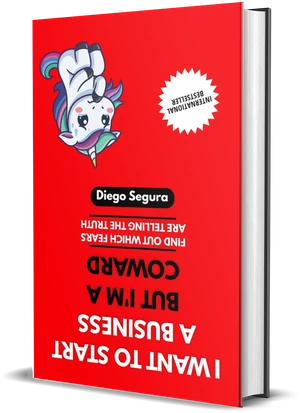
I Want to Start a Business but I'm a Coward, chapter 11: Beginning while afraid
Questions about entrepreneurship as experimentation.
What does entrepreneurship as experimentation mean for me?
It means you test instead of predicting success. Results stay unknowable until you actually try something.
Is a small start just a weaker big start?
No, a small start is the version that finds out. It gets you a real answer sooner.
How small should my first test be?
Make it the smallest step that gets a real answer from a real customer. It should not simply be the cheapest idea.
Read the whole chapter.
This lesson covers one section of chapter 11, “Beginning while afraid”. The book goes further, with the full evidence, the stories and every exercise.
Lessons in this chapter.
- 01 Waiting Until You Feel Ready: Why It Keeps You Stuck.
- 02 Fear of Failure as Motivation: Brake and Engine.
- 03 Entrepreneurship as Experimentation: Test, Don't Bet.
- 04 Lifestyle Business vs Startup: Small Is Not Lesser.
- 05 Hannah Arendt Natality: Your Capacity to Begin.
- 06 Write Down Your Fears Exercise: Sort Into Three Piles.
- 07 Start Small or Give Up: Make the Call in Writing.
- 08 Deep Time Perspective on Anxiety: The Long Wall.