


















Leaders admitting weakness: When It Costs You.
Leaders admitting weakness can pay a real cost, while peers making the same admission did not, in three 2018 experiments. Kindness seems to depend partly on where you sit. However, pairing the admission with a plan usually softens the verdict.
What the experiments on leaders admitting weakness found.
Kerry Roberts Gibson, Dana Harari and Jennifer Carson Marr ran three laboratory experiments. When a peer admitted a weakness, it triggered no costs. But when the person held a higher position, listeners saw lower status and more conflict. Also, influence fell and the relationship got worse. Same words, different cost.
Why your position is probably safe.
When you start something small, you're rarely the senior person in the room. Instead, you're asking, pitching, applying or trying. So the people you fear are mostly peers, family, friends or customers. The experiments did not test admitting weakness upward, so they only show your position isn't the risky one.
Pair the admission with a plan.
Later, if people depend on you, add what happens next. For example, when you admit a mistake to a customer about a late delivery, give the new date. Then explain what you changed so it won't happen again. Also, the 2022 Mannheim follow-up found that self-compassion narrows the gap between self compassion and self criticism in your own verdicts.
Practise leaders admitting weakness the safe way tonight.
Write one mistake you owe someone, then add the new date and the change you will make.
Say your harshest sentence aloud, and ask whether you'd say it to a friend.
From the book.
So the same confession that costs a peer nothing can cost a boss something real, and that's more precise than "people are kind". Kindness toward a visible weakness seems to depend partly on where you sit in relation to the person judging. When you're the one in charge, the people who depend on you may need you to look certain, and an admission can unsettle them.
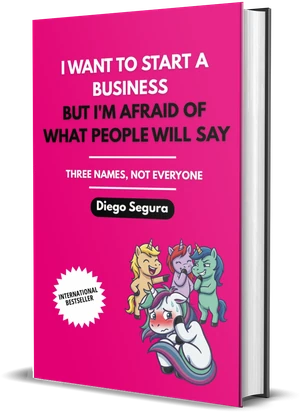
I Want to Start a Business but I'm Afraid of What People Will Say, chapter 3: Kinder than you think
Questions about leaders admitting weakness.
Is leaders admitting weakness always a mistake?
No, but in the 2018 experiments it carried costs that peers did not pay. Pairing it with a plan helps.
Why does a plan matter when admitting a mistake?
Because "I got the timing wrong" alone leaves people anxious. Adding the new date and the fix gives them something solid.
How does self-compassion help?
A 2022 follow-up found self-compassionate people judge their vulnerable moments less harshly. Their verdict comes closer to the one they'd give others.
Read the whole chapter.
This lesson covers one section of chapter 3, “Kinder than you think”. The book goes further, with the full evidence, the stories and every exercise.
Lessons in this chapter.
- 01 Is vulnerability a weakness: The Gap You Can Test.
- 02 Beautiful mess effect: Others See Courage.
- 03 Why am I so hard on myself: Two Reasons.
- 04 How others see your failures: Collect Verdicts.
- 05 CV of failures: What One Researcher's List Showed.
- 06 Leaders admitting weakness: When It Costs You.
- 07 Froze in an interview: What He Really Saw.