


















Status quo bias examples: why your job never ends.
The clearest status quo bias examples start with your own payroll, which runs because it ran last month. In 1988 Samuelson and Zeckhauser also showed that people reliably pick options labelled as already theirs. So staying never feels like something you do.
Nobody decides to keep you.
On a fixed date every month, a file runs and pays you. However, no meeting ever discusses your continued employment, and nobody signs anything. Your manager never chooses you again for another thirty days. Instead, the file runs because it ran before, and only an active step can stop it.
Leaving, by contrast, needs a scheduled conversation, a written document and a date you must defend. Therefore one path demands an act of will, while the other demands nothing, not even a thought.
Status quo bias examples from the research.
Samuelson and Zeckhauser gave people the same choices twice, once with no history and once with one option already theirs. For example, they tested budgets, portfolios and job offers. In every case, people favoured the option labelled as their own, even with identical numbers.
A whole career without one change.
Then the researchers studied university faculty who could reallocate retirement accounts every year at no cost. As a result, they found the median participant made zero changes across an entire working lifetime. Also, Ameriks and Zeldes studied the same institution from 1986 to 1996. They found 47 per cent never changed contributions, 73 per cent never changed investments, and 44 per cent changed nothing.
Spot status quo bias examples in your own week.
Write down three things in your life that continue only because nobody stopped them.
Then mark which of those three you would actively choose again tonight.
From the book.
There's no meeting where your continued employment gets discussed and agreed, nobody signs a document, and your manager does not sit down on the last Friday of the month, weigh you against the available alternatives, and choose you again for another thirty days. The file runs because it ran last month, and it will run next month for the same reason, and the only thing on earth that stops it is somebody actively doing something.
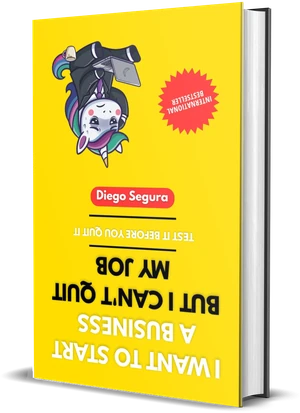
I Want to Start a Business but I Can't Quit My Job, chapter 7: Why you have not decided already
Questions about status quo bias examples.
What are simple status quo bias examples at work?
Your salary file runs each month without anyone deciding to keep you. Leaving, however, requires a conversation, a document and a date.
Who first studied the status quo alternative?
William Samuelson and Richard Zeckhauser published the work in 1988 in the Journal of Risk and Uncertainty.
Where does the 47 per cent figure come from?
It comes from John Ameriks and Stephen Zeldes, not from Samuelson and Zeckhauser. Their data covered 1986 to 1996.
Read the whole chapter.
This lesson covers one section of chapter 7, “Why you have not decided already”. The book goes further, with the full evidence, the stories and every exercise.
Lessons in this chapter.
- 01 Status quo bias examples: why your job never ends.
- 02 Omission bias: why not acting feels safer.
- 03 Career inaction: when staying is just a default.
- 04 Reversal test: would you take your job again.
- 05 When to kill a side project: the day you knew.
- 06 Parents chose my career: the first step was theirs.
- 07 Should I quit my job test: reading your answer.